
Maui Real Property Tax Rate 2026 – 2027
Continued Relief for Residents, a Steeper Climb for Second Homes
June 9, 2026
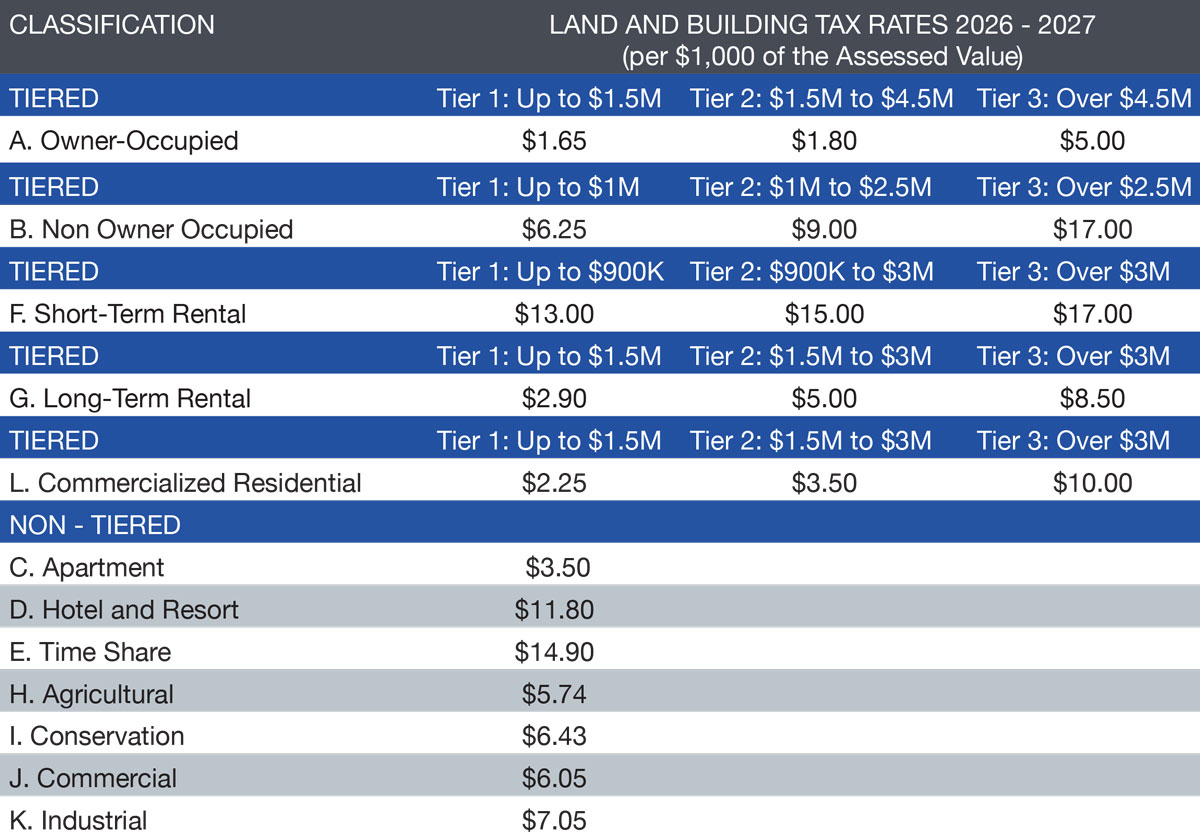
Maui County's property tax rates for the fiscal year beginning July 1, 2026, were adopted by the County Council on May 15, 2026, under Resolution No. 26-69, FD2. Compared to the prior year, the new structure continues a now-familiar pattern: modest relief for resident homeowners, paired with higher rates and lower thresholds for second homes, short-term rentals, and luxury properties. For owners and prospective buyers alike, the details are worth understanding clearly.
How Maui's Tiered System Works
A point of frequent confusion is the assumption that a single rate applies to a property's entire value. It does not. Maui uses a marginal tier system, much like a graduated income tax: each portion of a property's assessed value is taxed at the rate for its tier, not one rate across the whole amount. This is true for every tiered classification — owner-occupied, non-owner-occupied, short-term rental, long-term rental, and commercialized residential.
For example, a non-owner-occupied home assessed at $3,000,000 under the new rates is taxed as follows: the first $1,000,000 at $6.25 per $1,000, the next $1,500,000 at $9.00, and the remaining $500,000 at $17.00 — a total of $28,250, rather than the $51,000 that applying the top rate to the full value would suggest. Understanding this method is essential to reading any year-over-year comparison accurately.
Owner-Occupied Residences
For owner-occupied homes — primary residences with the homeowner exemption on file — this is a favorable year. The Tier 1 threshold rose from $1,300,000 to $1,500,000, so more of a home's value is taxed at the lowest rate of $1.65 per $1,000. The Tier 3 rate, which applies to value above $4,500,000, was reduced from $5.75 to $5.00. For most resident homeowners the effect is a flat-to-slightly-lower bill; for higher-value primary residences, the Tier 3 reduction offers more meaningful savings. The changes continue the county's recent emphasis on easing costs for residents whose homes have appreciated sharply.
Non-Owner-Occupied Residences
The non-owner-occupied category, which covers most second homes and investment properties, moved in the opposite direction. The top-tier rate held at $17.00 per $1,000, but the threshold that triggers it dropped from $3,000,000 to $2,500,000, bringing more properties into the highest bracket. The two lower tiers also rose — Tier 1 from $5.87 to $6.25, and Tier 2 from $8.60 to $9.00. Because each tier increased, most non-owner-occupied properties will see a higher bill this year, not only those near the new threshold.
Seen over three years, the trend in this category is consistent:
| Year | Tier 2 Band | Tier 2 Rate | Tier 3 Threshold | Tier 3 Rate |
|---|---|---|---|---|
| 2024–2025 | $1M – $3M | $8.50 | Over $3M | $14.00 |
| 2025–2026 | $1M – $3M | $8.60 | Over $3M | $17.00 |
| 2026–2027 | $1M – $2.5M | $9.00 | Over $2.5M | $17.00 |
Short-Term and Long-Term Rentals
Short-term vacation rentals (TVR-STRH) continue to carry among the highest rates in the county. The lower two tiers rose this year, and the top tier increased to $17.00 per $1,000 for value above $3,000,000. Long-term rentals, by contrast, remain comparatively favorable, with rates largely steady — a continuing policy nudge toward resident-serving leases over nightly rentals. Commercialized residential properties saw modest adjustments across their tiers.
Assessments Matter as Much as Rates
One point bears emphasis: a property's tax bill is the product of both the rate and the assessed value, and assessed values across West Maui have risen substantially in recent years — in many neighborhoods by significant margins over a short period. As a result, even owners in categories that saw rate relief may find their bills higher than in prior years, simply because the underlying assessment has climbed. When reviewing your assessment notice, it is worth looking at both the rate that applies to your classification and the assessed value itself.
A Shifting Target
Taken together, this year's resolution continues the county's effort to balance revenue against housing policy, but it is worth noting how the target has moved. Last year's increases fell most heavily on the very top of the market — the jump in the non-owner-occupied top-tier rate meant the highest-value estates saw the steepest percentage increases, while properties under $3 million were largely untouched. This year, by holding that top rate steady but lowering the threshold to $2.5 million, the county shifted the weight of the change onto the broad middle of the second-home market. A property assessed near $3 million sees a far larger year-over-year increase this cycle than it did last, while the highest-value estates see comparatively less. The pattern reflects an ongoing recalibration: each year the structure reaches a little further into the ranges where most West Maui second homes actually trade. Layered on top of assessed values that have climbed sharply in recent years, the result is that many non-resident owners will see meaningfully higher bills — even as resident homeowners continue to receive modest relief.
More Maui Real Estate News


MARY ANNE FITCH
REALTOR® · RB-15747 · SENIOR PARTNER
GLOBAL LUXURY SPECIALIST
